How Referee Signals Help Spectators Read a Match
Referee signals help spectators follow decisions at a glance. Learn what whistles, gestures and announcements can tell you when play is noisy or far away.
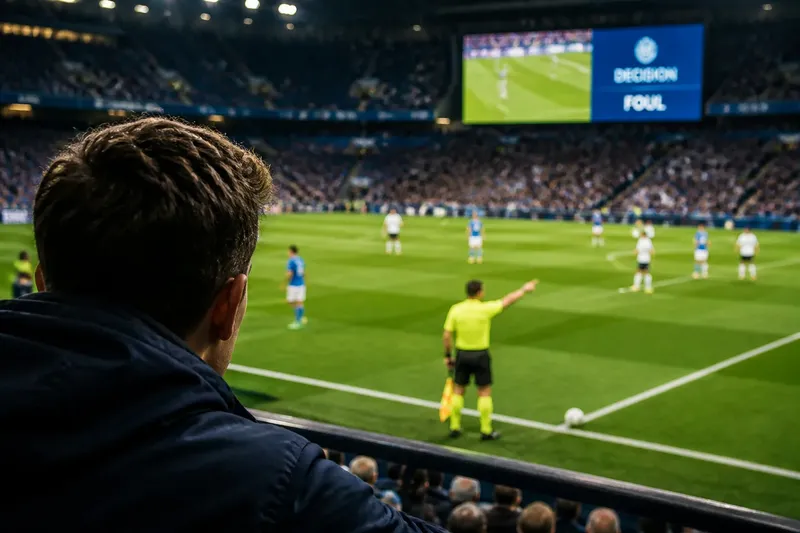
A whistle cuts through the noise near the touchline, a player slows, and the official points across the field. Even from a distant seat, that movement gives you a clue about what happens next. Referee signals help spectators read a match by making a decision visible as well as audible.
Officials may communicate through gestures, whistles, words and, at some events, screens or public-address announcements. Each channel has a different job: a whistle can interrupt play, a gesture can indicate a decision or direction, and an explanation can add detail that the gesture alone does not provide.
These cues are useful when the venue is loud, the official is far away or you missed the incident. They are not a complete account of every rule. Think of them as practical prompts for following what happens next, rather than a substitute for the competition’s rules.
Signals depend on the sport and its officiating conventions
There is no single universal language of referee gestures. The meaning of a movement depends on the sport and the competition’s rules and conventions, so a signal familiar from one game may not mean the same thing in another.
For example, a directional point can indicate where play is to proceed in a particular sport, while another sport may use a different gesture or procedure for a comparable restart. If you are unsure, check the event’s spectator guide or the governing body’s official rules for that sport; do not assume a gesture has the same meaning across games.
Within a given competition, signals are intended to help officials communicate decisions and their practical consequences. The exact movement and when it is used are set by that sport’s procedures, rather than by one shared system across all sports.
A referee may blow a whistle, make a gesture, speak to a nearby player and communicate with a colleague or scorer. Those actions can serve different audiences and moments, even when they follow one another quickly.
Whistles, gestures and announcements answer different questions
Think of officiating communication as a set of options, not one perfect method. A cue that suits a fast-moving moment may not explain a complex decision, while a lengthy explanation may be unnecessary when play needs to resume.
- Whistle: If you hear a whistle, check whether play has stopped or paused and then watch for the official’s next action; if you cannot see the official, follow the players’ response while avoiding assumptions about the reason.
- Gesture: If the movement is clear, use it to understand the broad decision or direction indicated in that sport; if it is obscured or unfamiliar, look for the restart and consult the event guide rather than guessing.
- Spoken explanation: If you are close enough to hear the official, listen for an instruction to the players involved; if the words are inaudible, treat the gesture and subsequent play as clues, not as a full explanation.
- Public announcement: If the venue uses a microphone to explain a decision, listen for context; if no announcement follows, rely on the official’s on-field actions for the immediate status of play.
- Scoreboard or screen: If a display provides a label or update, use it to add context; if it is blank or delayed, keep watching the official because the screen may not show what happens next.
- Replay: If a replay is shown, use it to see the incident from another angle; if no ruling is displayed, do not treat the footage itself as the official decision.
Imagine you are watching a close contest from an upper row and a player suddenly stops. The whistle draws your attention, the official points towards one side, and a screen displays a short decision label. You can see that play is interrupted and identify the immediate direction; if the label does not explain the incident, the precise reason remains uncertain until an official explanation or the sport’s procedures clarify it.
Timing and visibility help you read a signal
A signal is easier to interpret when you notice when it happens and what follows. Officials may need to move to a clearer position, make a gesture more visible or communicate with a colleague, so look for the whole sequence rather than decoding one hand movement in isolation.
Notice whether the official first stops play, then indicates a direction or location, and then speaks with a player or colleague. The order can help distinguish an immediate instruction from a follow-up explanation, although the exact sequence varies by sport.
Distance and viewing angle matter. From behind an official, a gesture may be hidden; from the side, the same movement may be easy to see. If you miss it, the whistle and players’ response can still help you follow the practical consequence. A team moving into a restart position, for instance, offers a clue about what comes next, but does not necessarily explain why the decision was made.
Technology can add context without making the call
A screen, microphone or replay system can make some decisions easier for spectators to follow. A display may show a short label, and an announcement may reach people who cannot see the official. Replay can show why an incident is being reviewed, but footage is not itself the referee’s decision.
These tools are not available at every venue or competition, and their timing can differ from the on-field signal. If information on a screen arrives later, watch the official to see whether play remains stopped or is ready to restart.
A gesture is quick but may leave out detail. Speech can be more specific but may reach only people nearby, while a screen can address a crowd but is easy to miss. The best clue depends on the question you have and the procedures used at that event.
Which referee signal should you watch first?
What does the whistle tell me?
A whistle tells you to shift attention because play may have stopped, paused or otherwise been interrupted. Watch what the official does next, since the sound alone often does not identify the decision or its consequence.
Why does the official point in a direction?
A directional gesture may indicate where action is to proceed, depending on the sport’s conventions. Use it as a clue to the next phase of play, not as a full account of the incident.
Why might an official repeat or enlarge a gesture?
A gesture may have been blocked or difficult to see from part of the playing area. A clearer or repeated movement can make the signal easier to see; check the players’ response before deciding what it means.
Should I rely on the crowd’s reaction?
The crowd’s response can alert you that something has happened, but it is not an official signal. Watch the official and the players’ next movements to understand the practical result.
Match the cue to the question you have
If you want to know whether play has stopped, attend to the whistle and the official’s actions. If you want to know where action is headed, look for a directional gesture and the players’ response. If you want to understand why a decision was made, listen for an explanation or check whether the event provides an announcement or display.
That approach works whether you are new to a sport or already know its broad rules. Rather than trying to memorise every gesture before a match, build your understanding from what you can observe: the official’s cue, the players’ response and the next phase of play.
Referee signals help spectators follow decisions without turning every stoppage into a rulebook exercise. When the next whistle cuts through the noise, watch the official, then check where the players move. If the reason remains unclear, the competition’s spectator guide or official rules are a better source than a guess from the stands.